Solutions
Reach your customers shortly after their experience.
With feedTRACK you can collect feedback online, on site or through a combination of channels. All in one CX solution.
Online collection
Reach customers in the channels they use and get feedback quickly and easily.
- E-mailPersonalized e-mail invitations. You know who is responding.
- SMSReach customers directly on their phone. You know who is responding.
- WebFeedback right during the visit to your website.
- AppA survey right inside your mobile app.
- NewsletterAdd a survey to the communication you already send to your customers.
One-off or continuous, depending on the project's goal.
On-site collection
Capture the experience right where the customer used the service or made the purchase.
- QR codesSimple feedback collection via QR codes at branches, events, on receipts and more.
- InterviewerAn interviewer approaches customers and records their answers right on site.
- KiosksLet customers rate their experience instantly on site.
Continuous collection right at the moment of experience.
Combined collection
Connect several channels and follow the customer experience across the whole journey.
- E-mail + SMSReach customers according to the contacts available and their preferences.
- E-mail + QR code / kioskCombine personalized invitations with feedback collected on site.
- E-mail + web / newsletterConnect targeted surveys with broader feedback collection.
- QR code / webCollect feedback even without your customers' contacts.
Different collection methods to suit each survey.
Not sure which collection method suits you best?
We'll help you choose the right channels and set up the solution around your customers, touchpoints and what you need to find out.
Tell us what you need to solve. Together we'll find the right way to collect feedback.
Instant feedback
feedTRACK ensures automated feedback collection from your customers. It can obtain information immediately after an interaction and deliver it to you in a clear format in the shortest possible time. It can handle even very large numbers of customers.
Do you want to know how customers rate you, what your strengths are, and where the opportunities for improvement lie? Thanks to easy implementation and ready-made solutions, you can start listening to the voice of the customer in a short time, improve, and gain an edge over the competition.

Outreach
Most often, the customer is contacted by e-mail or SMS. The outreach is designed in line with your company identity and responsive design and can be personalized according to the type of interaction and customer.

Tailored questionnaire by interaction type
We prepare questionnaires according to the type of customer interaction using metrics such as NPS, CSAT, CES, FCR, including open-ended questions. The questionnaire is responsive, visually adapted to your corporate identity, and variable based on different criteria (e.g. segment, product, or interaction type). We also offer internal employee satisfaction surveys (eNPS or post-onboarding feedback).

A thank-you message that completes the positive impression
After completing the questionnaire, the customer can be shown a thank-you message tailored to their level of satisfaction. It can be complemented with a link to a Google review, your website, and social media, or also with a discount code, voucher, or another form of reward.
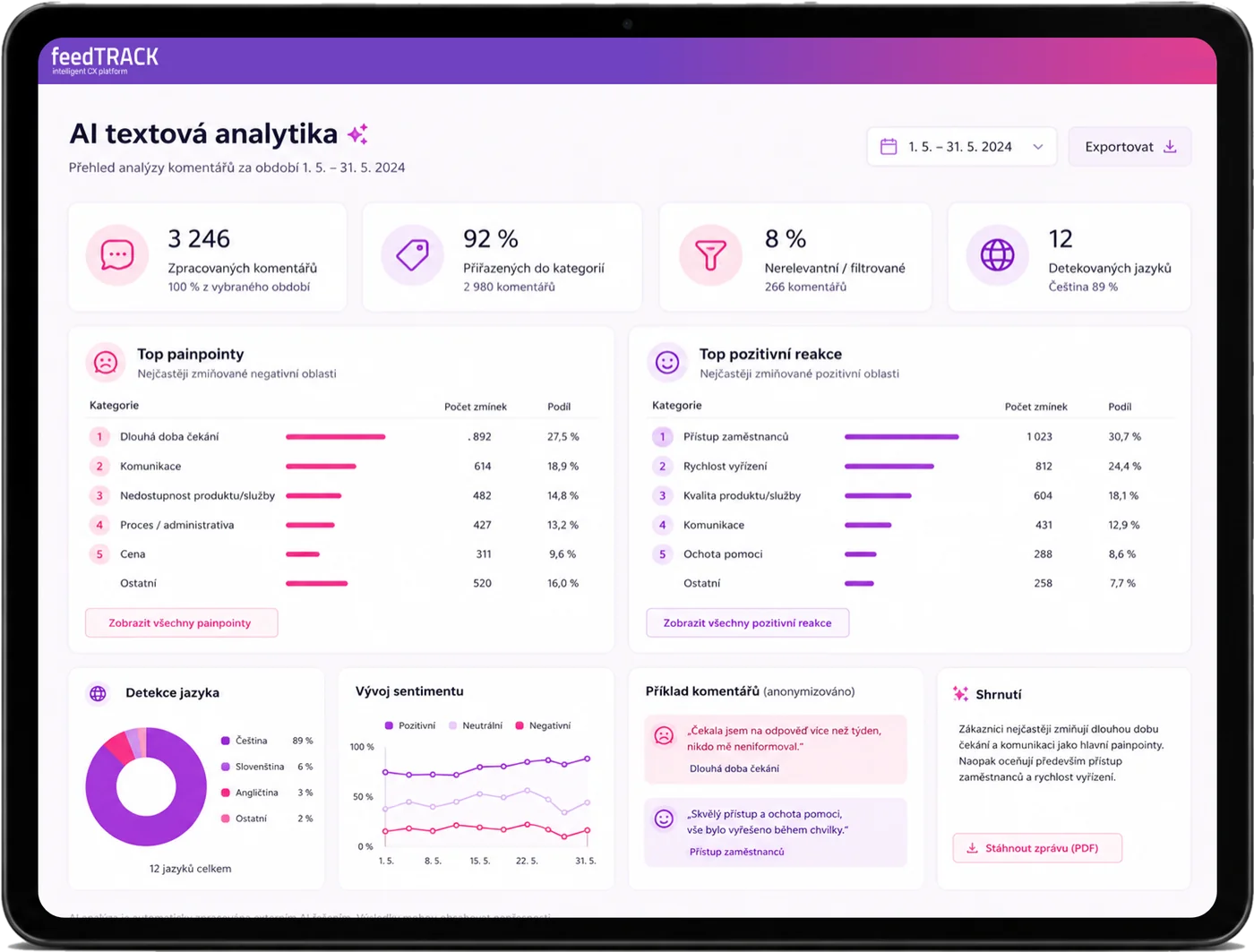
We read thousands of comments for you
AI uncovers the main topics, the sentiment and your customers' most frequent pain points. In moments, scattered feedback turns into clear priorities for your next decisions.
- AI categorization
- sentiment
- multiple languages
- automated reports
Metrics

Net Promoter Score (NPS)
Net Promoter Score (NPS) is a simple loyalty measurement method used to achieve more accurate results related to company growth. Using NPS, we measure customers’ willingness to recommend a product, service, or company to their friends or acquaintances. NPS can therefore help identify loyal customers.
Most commonly used question wording for NPS measurement: “Would you recommend our company based on your experience?”
Measurement: On a scale from 0 to 10, with ratings divided into 3 categories:
- promoters (ratings 10 and 9),
- passives (ratings 8 and 7),
- detractors (ratings 6 to 0).
Promoters are the most enthusiastic and loyal customers, while detractors are perceived as providers of negative value for the company. Passives are neither positive nor negative, and if they get the chance to switch to a competitor, they may choose to do so.
Calculation: NPS = % promoters – % detractors (the score ranges from -100 to +100)

Customer Satisfaction Score (CSAT)
Customer Satisfaction Score (CSAT) is a metric used to measure customer satisfaction with a given product, service, or experience. Thanks to this metric, we can identify areas for improvement and then take steps to improve products, services, and employee behavior.
Sample question: “How satisfied were you overall?”
Measurement: Most commonly on a scale from 1 to 5 (although another scale range may also be used), and different symbols may be used instead of numbers (for example smileys or stars).
Calculation: Average score of all responses (most often in %).

Customer Effort Score (CES)
Customer Effort Score (CES) is a metric used to measure the effort customers must make when interacting with a company, product, or service. It is based on the idea that if a customer has to exert only minimal effort during interaction with a company, they will be more satisfied and more loyal.
Sample question: “How easy was it for you to complete this process?”
Measurement: Most commonly on a scale from 1 to 5 (although another scale range may also be used).
Calculation: Average score of all responses (most often in %).

Employee Net Promoter Score (eNPS)
Employee Net Promoter Score (eNPS) is a metric that measures employee loyalty and is based on the NPS concept. It helps organizations identify the level of engagement and satisfaction among employees. Frequent eNPS measurement enables companies to detect issues expressed by employees.
Sample question: “How likely is it that you would recommend working at this company to your friends and acquaintances?”
Measurement: On a scale from 0 to 10, with ratings divided into 3 categories:
- promoters (ratings 10 and 9),
- passives (ratings 8 and 7),
- detractors (ratings 6 to 0).
Calculation: eNPS = % promoters – % detractors (the score ranges from -100 to +100)

First Call Resolution (FCR)
First Call Resolution (FCR) is a metric used in call center evaluation to measure the efficiency of call center teams. This indicator evaluates how quickly a call center employee can resolve a customer’s issue or question. A high FCR rate means fewer repeat calls from the customer regarding the same issue and higher satisfaction.
Sample question: “Was your request resolved during the first call?”
Calculation: FCR = (number of cases resolved on first contact) / (total number of cases) × 100%
Interested in more? Here you can look at selected case studies.